A brighter vision.A real future.With a safer foundation.
Global School OS is an early-stage infrastructure concept designed to help districts coordinate responsible AI use, educational-purpose checks, traceable system activity, and protected learning evidence across connected tools.
Schools should not have to choose between innovation and responsible oversight.
District technology environments can include disconnected platforms, different policies, repetitive workflows, and incomplete records. Each added AI tool may introduce another place where purpose, access, and accountability need to be understood.
Too many disconnected systems
Teachers and administrators may move between attendance, learning, assessment, communication, and student-information tools that were not designed to work as one governed infrastructure.
Less time for teaching
Documentation, grading, planning, compliance workflows, and duplicate data entry can compete with the time educators need for instruction and individual student support.
A score can miss the learner
Response time or performance data may show what happened without explaining the creative thinking, persistence, or alternative paths behind it.
Purpose must remain visible
Districts need practical ways to evaluate why a tool or user is accessing information and to preserve records for authorized review.
Five pillars. One coordinated foundation.
Each pillar addresses a different governance need. Together, they describe the intended architecture of Global School OS, subject to continued development, testing, district requirements, and applicable law.
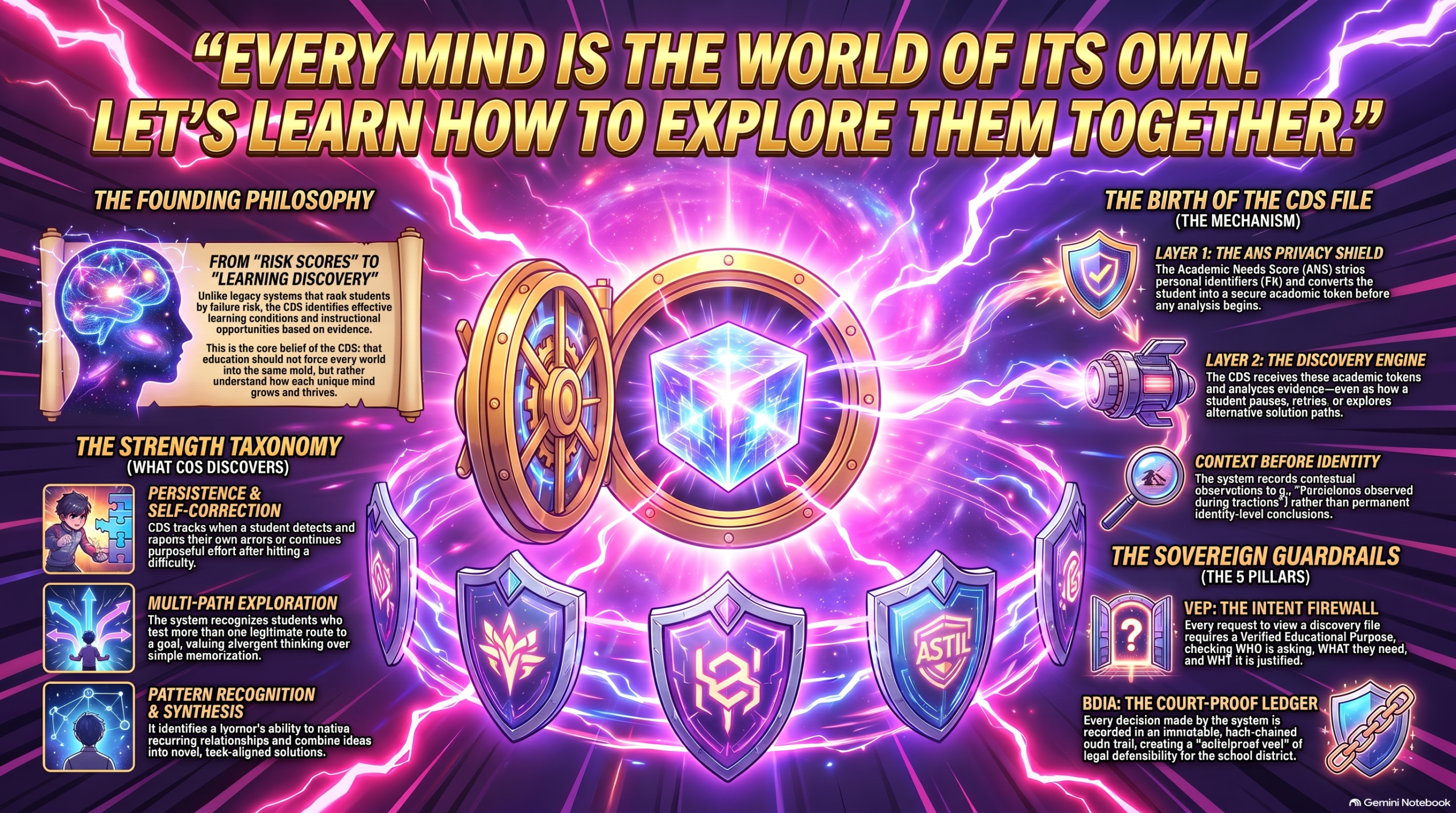
ANS
A proposed framework for organizing permitted academic indicators and supporting more contextual conversations about student needs.
VEP
Designed to evaluate who is asking, what is requested, and why the access may serve an authorized educational purpose.
BDIA
Intended to support efficient processing while preserving record-level traceability for authorized review.
CES
A proposed consistent error language intended to make failures easier to identify across connected systems.
ASTIL
A tenant-separation design intended to reduce the risk of data or configuration crossing organizational boundaries.

“Every mind is a world of its own. Let’s learn how to explore them together.”
The Creative Discovery System is inspired by the belief that learning evidence should help educators ask better questions—not define a student by a single delay, score, or label.
Different roles. Shared governance.
The proposed infrastructure is intended to give each authorized role an appropriate view while supporting common purpose checks and traceability.
More time for instruction
Reduce disconnected workflows and support clearer access processes around the tools teachers already use.
Context beyond a score
Help qualified adults consider evidence of effort, exploration, and learning conditions without turning observations into permanent identity claims.
Clearer visibility
Explore understandable records and consent workflows shaped by district policy and applicable requirements.
Coordinated oversight
Bring relevant system activity and policy-aligned controls into a more coherent authorized view.
Infrastructure thinking
Coordinate existing tools through a shared governance foundation instead of adding another disconnected application.
Evaluate the concept
Collaborate on requirements, safeguards, implementation realities, and responsible pilot design.
Elizabeth Outlaw
CEO, Founder, Creator & Inventor of the Global School OS Infrastructure
Elizabeth’s work is rooted in lived experience. In 1986, the time she took to answer questions was interpreted as evidence of an SLD-related problem. Her experience was different: she was exploring many creative routes—sometimes fifteen different ways—to reach the answer.
That gap between what a system records and what a learner may actually be doing became a foundational question behind Global School OS.

Help shape responsible K–12 AI infrastructure.
Global School OS is seeking conversations with districts, educators, researchers, advisors, funders, and implementation partners interested in evaluating the concept and defining responsible next steps.